Showing posts with label Eggs. Show all posts

Wednesday, September 5, 2018

Quinoa "Fried Rice"


I make this dish so often I thought I'd share, just in case you'd like to add it to your weeknight repertoire. It comes together quickly, especially if you prep the sesame ginger sauce in advance. I like to make a double batch of the sauce to store in the fridge, as it keeps for several weeks.
It's the perfect dish for someone who is quinoa-curious, but maybe a little intimidated as well. See? There's nothing to be scared of.
You can vary the vegetables- I'll often use green beans in place of broccoli or throw in some chopped garlic scapes when they are in season. You can finish it with your favorite hot sauce, chopped cilantro or salty peanuts for a crunch.

You're now two pans and 30 minutes away from a dinner chocked full of high quality protein, fiber and stir-fried veggies. 
Quinoa Fried “Rice”
Serves 2 as a main dish
Ingredients
3 tbs. tahini
3 tbs. tamari soy sauce
2 tbs. honey or syrup
1 tbs. toasted sesame oil
2 garlic cloves
1-inch ginger root

½ cup quinoa
1 cup water or stock
2 tbs. oil of choice, divided
Small head of broccoli, about 1 cup chopped
1 small carrot,  grated
2 eggs 
2 tbs. sesame seeds
Chili flakes, if desired 
Directions
Place quinoa and water/stock in a small pot. Bring to a boil and turn down to a simmer. Cook for 15-20 minutes, covered, or until all liquid is absorbed. Remove lid, fluff and set aside.
To make the sesame ginger sauce, combine tahini through ginger in a blender and process until smooth. Set aside.
Beat eggs in a small bowl. Season with a dash of salt and pepper.  
Heat 1 tbs. oil over medium heat in a large pan. Add eggs and scramble quickly. Remove to a small bowl and break up into small pieces. Wipe pan clean. Add remaining tbs. of oil to the pan along with carrots and broccoli and stir-fry until bright and tender, about 5 minutes. Add cooked quinoa, scrambled eggs, 4-6 tbs. sesame ginger sauce and sesame seeds and continue to stir-fry for 3 minutes.  Taste and adjust seasoning with salt and chili flakes if desired.

Tuesday, April 11, 2017

Dabbling in Naturally Dyed Eggs


I've spied many gorgeous shots of naturally dyed Easter eggs over the past few years, and today I decided to give a go. Unfortunately, I didn't exactly plan for the project, so I had to work with the ingredients I had on hand.

Using this Martha Steward article as a jumping off point, I read through the instructions and raided my fridge and pantry. I came up with a plump red radish, a large red onion, several yellow onions, and a jar of turmeric. In an ideal world I would have had red cabbage too, but alas, no dice.

Important to note: I also lacked white eggs. I had farm fresh eggs, which meant most were varying levels of brown. I picked the lightest four and marched on.


I wanted to try both the cold dip and hot boil methods, so I hard-boiled two eggs and kept two fresh.

Here are the steps I followed:

Combine 4 cups of water, 2 tablespoons of white vinegar and a teaspoon of salt. Split in to two small pots.

To one pot, I added the peels of a red and yellow onion (the first few layers) as well as a chopped radish. This was my red/purple pot.

To the other pot, I added 1 1/2 tablespoons of turmeric powder. This was my yellow/gold pot.

Bring each to a boil and simmer for 15 minutes, so that liquid is now saturated with color.

Add one fresh egg to each pot, and continue to cook for 30 minutes, rotating eggs every 5 minutes or so if they are not covered by liquid (mine were not).

Turn off heat, remove eggs to two separate mugs and strain liquid over each. For some reason, I had much more yellow dye than purple, so I was only able to add a hard boiled egg to the yellow mug. Let sit for an additional hour.


Remove eggs, gently wipe with a towel, and let dry. Voila! Mine were far from perfect- particularly the hot boil ones, but that made them kind of interesting too. The speckling reminded me to the bird eggs you find in a nest.

Next year, I am going to plan ahead, start with whiter eggs, experiment with some different colors (red cabbage is suppose to turn them blue) and maybe stick with the cold dip method for more even coverage. I'd probably start with more liquid too- do a double batch, instead of being so stingy.

Overall, a fun project, if you aren't too attached to perfect results. I think it would be really interesting to do with school age kids who could hypothesize about about the colors (some are surprising) and experiment on their own.

Relax. Eat Well.

Friday, February 17, 2017

Avocado Egg Salad


To be honest, egg salad was never a food I enjoyed much, I think mostly because of it's reputation towards spoilage due to the thick mayonnaise that surrounds it. But somehow my interest was piqued when I came across the idea of replacing the mayo with mashed avocado. I love the combination of egg and avocado- a few slices almost always grace my breakfast bowls. So I gave it a go, and now I am hooked.


The egg salad stores well and is the perfect snack or light meal with a few cucumber slices or on a bed of spinach. Of course, it pairs with toasty bread beautifully as well, if you are more inclined to sandwich structures.

It took me awhile to perfect my hardboiled egg, but I think I have finally figured out the tricks. The first is to use eggs that are not fresh from the coop- ideally a week or two old. The second (and I think most important) is to use an ice bath after the eggs have cooked. I am not one for finicky cooking techniques such as ice baths, but this step is non-negotiable in this recipe. It results in shells that peel off effortlessly and makes the process a breeze.

Avocado Egg Salad
Serves 2-3

Ingredients
3 eggs

1 avocado
1 tsp. dijon mustard
1/4 tsp paprika
1/4-1/2 tsp. salt
1/8 tsp. black pepper
2 scallions, minced

1 cucumber

Directions

Place eggs in a small saucepan. Cover with cold water, cover and bring water to a simmer over medium-high heat. Once simmering, turn off heat and let sit, covered, for 15 minutes. In the meantime, prepare a bowl of ice cold water. Drain eggs and transfer to ice bath for another 15 minutes before peeling. Chop roughly.

Mash avocado, with mustard, paprika, salt and pepper. Place in a bowl and toss with chopped eggs and minced scallions. Serve immediately or chill in refrigerator.

To serve, spread on to sliced cucumber, or if preferred, toasted bread. Sprinkle with an extra garnish of paprika.

Relax. Eat Well.

Tuesday, May 5, 2015

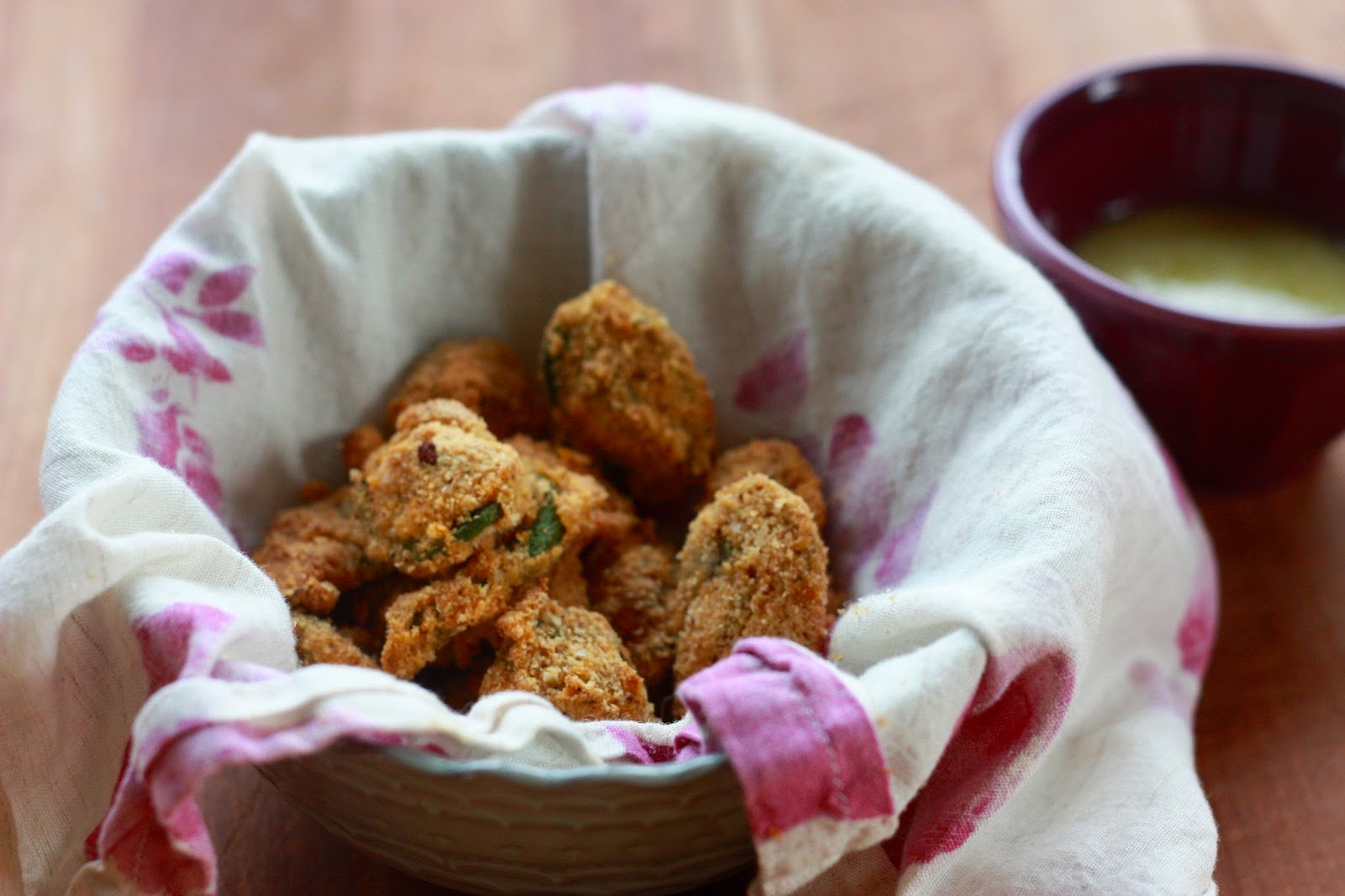
Crispy Fiddlehead Poppers


Woohoo!!! It's that time of year again. Wild ramps and fiddleheads are popping up- spring it is so sweet!


I absolutely love ramps, also known as wild leeks- the leaf is similar to a chive and the root bulb to a shallot. It is a member of the alium family, and offers hints of both onion and a mild garlic flavor.

In the past, I have posted recipes for Ramp Butter and Wild Dandelion Ramp Pesto. This year, I wanted to share a Fiddleheads recipe, which only seems overdue, given my name and love for the wild fern. 

Nutritionally speaking, these shoots are rich in Vitamin A and C, iron and manganese as well as omega-3 fatty acids.


It seems as though most recipes out there center on either pasta, garlicky sautés or pickling, so I wanted to share something a little different. This recipe is a bit addicting, and I can imagine it would go over well across the age groups. Not a bad way to get your ferns in. 


These poppers are super quick and easy, and pretty fool-proof. They reheat well- just pop them back on a sheet pan in a 350 degree oven for 5 minutes or so. You want to enjoy these babies hot. 

I enjoy them by themselves, but a dipping sauce does truly bring them over the top. Today I mixed equal parts plain whole milk yogurt with a lemon vinaigrette I had in the fridge, and that was delightfully rich yet tangy. I can imagine they would be great with any sort of aioli you could dream up, or my vegan raw almond "aioli" (with or without the cilantro, depending on your stance).

Crispy Fiddlehead Poppers
Serves 2

Note: if you do not have access to sumac, replace with garlic granules or powder.

Ingredients

2 cups fiddlehead ferns, washed well and trimmed

1/2 cup blanched almond flour
1/2 tsp sumac
1/4 tsp. smoked paprika
1/2- 3/4 tsp. sea salt (depending on your salt level preference)

1 large egg

1 tbs. oil for drizzling

Directions

Preheat oven to 400 degrees.

Clean and dry and fiddleheads well, trimming to a 1/2 inch below the furling head.

In a medium bowl, mix together almond flour, sumac (or garlic), smoked paprika and sea salt.

In a separate medium bowl, beat egg. Add in fiddleheads and toss well. Using a slotted spoon, remove fiddleheads from egg, letting excess drip off. Move in to almond flour mixture bowl and toss to coat very well.

Place breaded fiddleheads on a parchment paper lined baking sheet. Drizzle with oil. Bake for 10 minutes. Rotate pan and continue to bake for another 5 minutes. Remove pan, flip fiddleheads and return to oven for the final 5 minutes.

Serve immediately with your favorite dipping sauce.

Relax. Eat Well. 


Tuesday, November 25, 2014

Sage and Cranberry Cornbread Stuffing


Phew, I made it before Thanksgiving. I'm telling you- this decreasing daylight thang is really messing with my game! Since we all know camera flash/artificial light and food photography don't get along, it has been challenging to find a time to photograph my food while I am actually cooking! Thus the reason for the string of breakfast recipes as of late. Hopefully this one will break the trend.


OK, so who doesn't like a good 8 ingredient recipe for the holidays? This one is beyond easy, especially if you have some leftover cornbread, as I did, from a pre-holiday Friendsgiving.


The cornbread I used was nice- I included a link to it in the recipe below. If I made it again to enjoy on its own, I would amp up the sweetness with 2 extra tablespoona of honey, and throw in an additional 1/2 teaspoon or so of salt. But I have to say, for the stuffing, it was pretty near perfect. It is gluten-free as well, which helps when feeding a crowd of diverse eaters.


Thanks to the chickens, these eggs were beyond fresh and so golden they were almost orange. Those chickies are definitely on the list of things I am thankful for this year.


You can use either fresh or dried cranberries here- the dried ones will add a touch more sweetness, and the fresh will give you a burst of tang. I did a combo, and really enjoyed what each had to offer.

This is certainly a more indulgent recipe, given the amount of butter, but with high quality ingredients it can certainly still fit into a healthy meal. Tis the season, right?!? Using fresh cranberries boosts the antioxidant load, particularly in the form of manganese and vitamin C.


Luckily my gorgeous little sister stopped by just in time to do a little last-minute modeling with the cornbread. On Saturday she leaves for a big move out to California, so this week has been a bittersweet goodbye.

Whether this dish graces your Thanksgiving table or makes it's way into the week of leftovers, I'll feel nothing but honored to be part of your holiday celebration.

Sage and Cranberry Cornbread Stuffing
Serves 6
Adapted from Claire Robinson of the Food Network

Ingredients

5 tbs. cultured butter, salted, divided
1 large yellow onion, chopped
12 or so sage leaves, fresh or dried
5 cups cornbread (I used this recipe, with honey instead of sugar)
2 large eggs, beaten
2 tbs. dried cranberries or 1/4 cup fresh (or both!)
3/4 tsp. salt
1/4 tsp fresh cracked pepper
1/2 cup water

Directions

Preheat oven to 375 degrees.

In a large saute pan, melt 2 tbs. of butter over medium heat. Add chopped onions, and cook, stirring often, until soft and beginning to brown. Remove into large bowl.

Heat remaining butter in the same pan over low-medium heat, until beginning to brown and separate. Add sage and let sizzle. Remove from heat.

Cut cornbread into cubes and add to the large bowl with onions, along with beaten eggs, salt, pepper and cranberries. Drizzle with browned sage butter and toss to coat. If more moisture is needed, add 1/2 cup of water to the butter pan to deglaze. Add, 1 tablespoon at a time, tossing in between, until stuffing is soft but not wet.

Butter a 8x8 pan, and fill with stuffing. Bake for 20 minutes, rotate and continue to cook for an additional 20 minutes. Remove from oven and let cool slightly before serving.

Relax. Eat Well.